


Meaning-Making After Trauma: Why Meaning Matters

Meaning-making after trauma is the process of integrating a traumatic experience into a larger understanding of one's life, identity, relationships, and worldview.
Trauma can divide a life into before and after.
Something happens that the psyche cannot simply file away as another ordinary experience. Assumptions about safety, trust, identity, relationships, fairness, or the future may be shaken.
Healing is often discussed in terms of reducing symptoms—and symptom relief matters enormously.
But eventually another layer of recovery may emerge.
The question changes from:
How do I stop feeling this?
to:
What does my life mean now?
This is the territory of meaning-making after trauma.
Meaning-making is not about pretending trauma happened for a reason.
It is not about finding a silver lining.
And it certainly does not require gratitude for suffering.
It is about gradually rebuilding a coherent relationship with yourself, your story, and the world after an experience has disrupted the assumptions that once held them together.
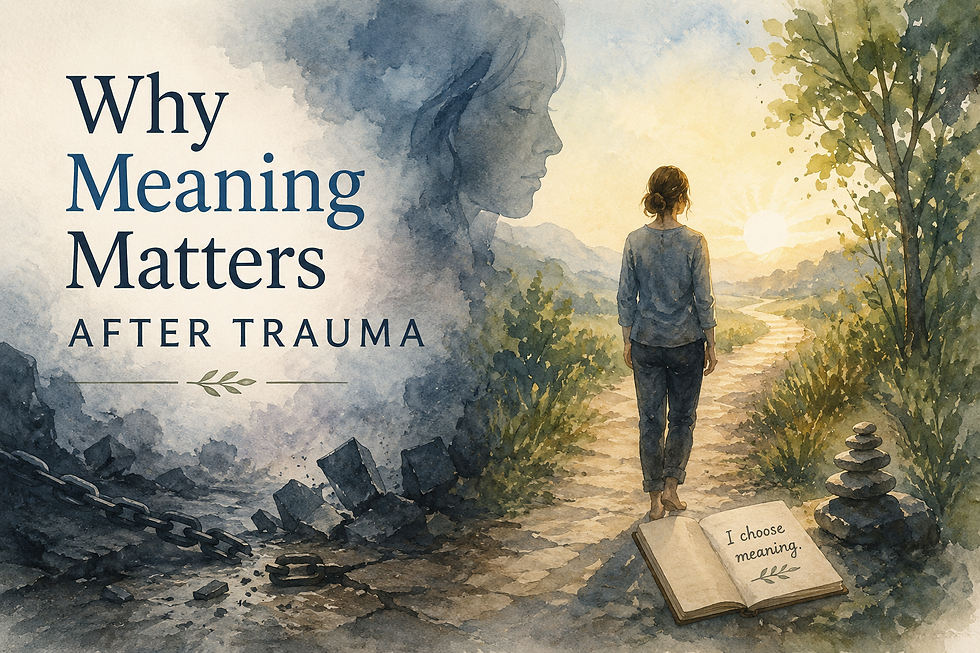
What Is Meaning-Making After Trauma?
Meaning-making after trauma is the process of integrating a traumatic experience into a larger understanding of one's life, identity, relationships, and worldview.
Before trauma, most people carry assumptions about how life works.
Some are explicit.
Many are not.
I am relatively safe.
I can trust my judgment.
People I love will be here.
If I do the right things, certain outcomes will follow.
I know who I am.
Trauma can rupture these assumptions.
The event ends, but the psyche is left trying to understand a world that no longer fits its previous map.
Meaning-making is part of constructing a new one.
Trauma Does Not Only Affect the Nervous System
Trauma has an undeniable physiological dimension.
The body learns.
The nervous system remembers.
Threat responses can persist long after danger has passed.
But human beings are not nervous systems floating in space.
We are also meaning-making creatures.
We create narratives about who we are, what happened to us, what other people can be trusted, what the future holds, and what our experiences say about our worth.
This is why two people can survive superficially similar events and emerge with profoundly different psychological meanings.
One person may conclude:
I am powerless.
Another:
People cannot be trusted.
Another:
I should have prevented this.
Another:
Nothing is safe.
Another:
My life can never be meaningful again.
These meanings can become as psychologically consequential as the memory itself.
Healing therefore may require more than calming the body.
It may also require examining the story the psyche constructed around what happened.
Meaning-Making Is Not the Same as Saying “Everything Happens for a Reason”
This distinction matters enormously.
Meaning-making does not require believing that trauma was destined, necessary, spiritually ordained, or secretly beneficial.
Sometimes terrible things happen.
There does not need to be a cosmic justification for them.
Meaning-making asks a different question.
Not:
Why was this supposed to happen?
But:
Given that this happened, how will I understand myself and my life now?
That shift returns agency to the survivor.
You do not have to make the event good.
You are allowed to decide what happens to its meaning.
Trauma Can Disrupt Identity
Trauma does not only alter memories.
It can alter identity.
Someone who once experienced themselves as confident may become hypervigilant.
Someone who trusted easily may become guarded.
Someone who believed they understood their family may suddenly see childhood differently.
Someone who organized life around achievement may discover that productivity no longer feels meaningful.
Sometimes trauma exposes identities that were already fragile.
Sometimes it shatters identities that had been stable for decades.
And sometimes recovery eventually requires acknowledging:
I cannot return to exactly who I was before this happened.
That realization can contain grief.
But it can also contain possibility.
The goal of integration is not necessarily to restore the previous self.
Sometimes it is to develop a larger self capable of holding both the person you were and what you now know.
Why “Getting Back to Normal” Is Not Always the Goal
After trauma, people are often encouraged to return to normal.
But what if normal no longer fits?
What if the experience exposed something about a relationship?
A family system?
A career?
A pattern of self-abandonment?
A belief about worth?
A way of living that was already unsustainable?
Recovery does not have to mean restoring the exact psychological organization that existed before trauma.
Sometimes healing involves reorganization rather than restoration.
The psyche asks:
What remains true?
What no longer belongs?
What needs grieving?
What needs protecting?
What needs reclaiming?
What kind of life can be built from here?
Those are questions of meaning.
Trauma, the Unconscious, and Repeating Patterns
Traumatic experiences do not always remain neatly contained in conscious memory.
They can influence relationships, expectations, emotional reactions, dreams, protective strategies, and the kinds of situations we repeatedly enter.
Sometimes we find ourselves reenacting relational dynamics we consciously insist we no longer want.
Sometimes the psyche seems magnetized toward familiar emotional terrain.
This does not mean we secretly want to suffer.
It may mean that unresolved experience continues organizing perception and behavior outside conscious awareness.
Bringing these patterns into consciousness creates the possibility of relating to them differently.
Read More:
Meaning-Making and the Shadow
Trauma can also alter what we permit ourselves to know about who we are.
Anger may become unacceptable.
Need may become dangerous.
Vulnerability may become shameful.
Power may become frightening.
Desire may disappear beneath survival.
Certain qualities may become pushed outside conscious identity because they are associated with danger, shame, helplessness, or loss.
From a Jungian perspective, some of this material may become entangled with the shadow—aspects of personality the conscious identity cannot comfortably recognize as its own.
Healing can therefore involve more than remembering what happened.
It may involve reclaiming what happened to the self because of what happened.
Read More: What Is Shadow Work?
The Difference Between Meaning and Explanation
One of the traps in trauma recovery is believing we need a perfect explanation before we can heal.
Why did they do it?
Why didn't I see it?
Why didn't someone protect me?
Why did this happen to me?
Some questions have answers.
Others never will.
Meaning does not require solving every mystery of the past.
Sometimes meaning emerges when attention shifts from the unknowable motives of others toward the life that still belongs to you.
What do I know now?
What matters to me now?
What boundaries became necessary?
What part of myself needs to be reclaimed?
What kind of relationships do I want to create?
What will I no longer abandon in myself to preserve belonging?
These questions move the center of gravity back toward the person who survived.
Meaning-Making Is Not Forced Growth
There is another important danger here.
The pressure to turn trauma into growth can become its own form of violence.
You do not owe anyone a beautiful transformation because something painful happened to you.
You do not need to become wiser.
More spiritual.
More compassionate.
More successful.
Or grateful.
Some losses remain losses.
Some wounds leave scars.
Meaning-making must emerge organically rather than being imposed as another expectation.
Growth is possible after trauma.
But growth should never become a requirement for proving that you healed correctly.
Post-Traumatic Growth and Psychological Integration
Some people eventually report meaningful changes following traumatic experiences: greater appreciation for life, clearer priorities, stronger boundaries, deeper relationships, spiritual or existential development, or a changed understanding of personal strength.
Psychology sometimes describes this as post-traumatic growth.
Importantly, growth and suffering can coexist.
A person can still grieve what happened while recognizing that they have changed.
They can wish an experience had never occurred while acknowledging that something meaningful emerged during recovery.
Psychological integration allows both truths to exist.
This should not have happened.
And:
I get to decide who I become now.
Those statements do not contradict one another.
How Depth-Oriented Therapy Approaches Meaning After Trauma
Depth-oriented psychotherapy is interested not only in what happened, but in how the experience became woven into the person's inner world.
How did it change identity?
What beliefs formed around it?
What protective parts emerged?
What became hidden?
What relationships now activate the old wound?
What appears in dreams?
What patterns continue repeating?
What meaning has the person assigned to the experience?
And perhaps most importantly:
Which meanings still belong—and which are ready to be revised?
This kind of work does not replace trauma stabilization or evidence-based trauma treatment when those are needed.
It addresses another dimension of healing:
the reconstruction of a life that feels psychologically coherent and personally meaningful.
Meaning-Making and Ego Integration
Trauma can create internal contradictions.
Part of me wants intimacy, and part of me does not trust anyone.
Part of me wants to rest, and part of me believes rest is dangerous.
Part of me knows it wasn't my fault, and another part still carries shame.
Part of me wants to move forward, and another part refuses to leave the past.
Integration does not require choosing which side is correct.
It begins by developing enough awareness to hold these conflicting experiences in relationship.
This is part of what I mean by ego integration: bringing wounded, protective, hidden, and conflicting aspects of the personality into a more conscious relationship rather than allowing them to operate independently outside awareness.
Read More:
Frequently Asked Questions About Meaning-Making After Trauma
What is meaning-making after trauma?
Meaning-making after trauma is the process of integrating a traumatic experience into one's understanding of identity, relationships, beliefs, and life story. It does not require believing the trauma happened for a reason.
Why is meaning important in trauma recovery?
Trauma can disrupt assumptions about safety, trust, identity, fairness, relationships, and the future. Meaning-making can help a person construct a more coherent understanding of life after those assumptions have been disrupted.
Do I have to find meaning in my trauma?
No. There is no obligation to discover a lesson, purpose, or benefit in suffering. Meaning-making should never be imposed. For some people, meaning emerges gradually through the choices they make after the experience rather than through the trauma itself.
What is post-traumatic growth?
Post-traumatic growth refers to positive psychological changes that some people report following highly challenging experiences, such as changed priorities, deeper relationships, greater appreciation of life, increased personal strength, or existential and spiritual development. It does not mean the trauma itself was positive or that ongoing distress represents failure to grow.
Can trauma change your identity?
Yes. Trauma can affect how people understand themselves, other people, safety, relationships, vulnerability, control, and the future. Part of recovery may involve integrating these changes into a broader and more flexible sense of identity.
Is meaning-making part of trauma therapy?
It can be. Different trauma therapies emphasize different aspects of recovery. Meaning-making may become particularly relevant when someone is working through changes in identity, worldview, relationships, grief, or existential questions following trauma.
Can I heal without forgiving the person who hurt me?
Yes. Forgiveness is not a prerequisite for trauma recovery. Healing can involve boundaries, grief, anger, acceptance of reality, self-compassion, meaning-making, and reclaiming agency without requiring forgiveness.
A Closing Reflection
Trauma writes something into the story of a life.
But it does not receive exclusive authorship.
There may come a point when healing becomes less about erasing what happened and more about deciding what the experience will—and will not—be allowed to mean.
You can grieve what was lost.
Question what you once believed.
Reclaim what went underground.
Build relationships differently.
Choose new boundaries.
Become someone you could not have imagined before.
Not because the trauma was necessary.
Not because suffering was secretly a gift.
But because the rest of the story still belongs to you.
Continue Exploring
If this article resonated with you, you may also enjoy exploring:


Comments